End-to-end credit decision intelligence for MSME lending
Make faster, more consistent credit calls at every stage-origination checks, underwriting, monitoring, renewals, and collections-powered by continuously updated borrower risk signals and deep proprietorship & partnership coverage
Speed up underwriting. Strengthen control. Stay ahead of risk
Built for bank and NBFC credit teams: faster underwriting, sharper risk control, real-time change alerts, and unmatched proprietorship & partnership coverage.
Underwrite faster
Enable faster, data-backed lending decisions with automated risk evaluation.
Underwrite thin-file MSMEs better
Credhive’s Dynamic BIR covers India’s deepest proprietorship & partnership pool, so you don’t treat non-registered borrowers like blind spots.
Catch hidden risk
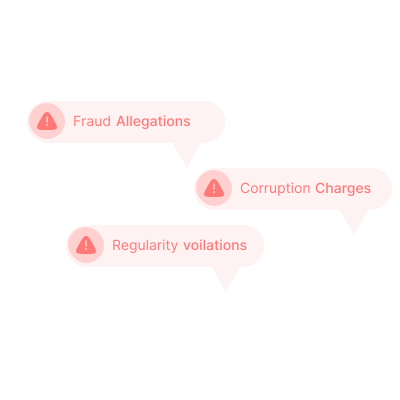
Identify early warning signals to proactively manage credit exposure.
Stay review-ready
Streamline loan assessment and monitoring to support high-volume lending efficiently.
Your entire credit lifecycle covered
From origination checks to renewals and collections-Credhive keeps every credit decision faster, consistent, and always based on the latest risk.
Faster origination checks
Credhive gives your front-line teams a live borrower snapshot at the point of intake-so KYB and pre-screening happens in minutes, not days. Instead of stitching data from multiple places, you get a single view that helps you quickly qualify, flag, and route cases before underwriting time is spent.
Better underwriting control
Credhive turns scattered signals into a decision-ready underwriting view that’s easier to standardize across analysts and defend in committee. It helps teams move from “report reading” to clear risk interpretation and control, improving consistency in approvals, conditions, and exceptions.
Real-time monitoring
Credhive keeps the borrower view continuously updated post-disbursement-so renewals and portfolio reviews aren’t based on stale snapshots. You can track changes over time and run reviews based on what changed, not by repeating the same checks from scratch.
Adverse updates for actions (collections / limit / terms)
When adverse events emerge, Credhive surfaces them as actionable alerts-so risk and collections teams can respond earlier by tightening terms, resizing exposure, or triggering reviews. It gives you the latest risk context exactly when the account needs intervention.
FAQs
Frequently Asked Questions
A Registered BIR is a comprehensive due diligence document built exclusively on statutory data. Unlike reports for unregistered firms, it aggregates official filings from the Ministry of Corporate Affairs (MCA), GSTN, and ROC for Private Limited, Public Limited, and LLP entities to provide a verified 'Source of Truth' for credit and risk assessment.
Traditional reports are often 'snapshots' that become obsolete the moment they are saved. Our product is a Live Data Layer. Instead of a static PDF, you access a dynamic engine that pulls real-time data from government portals, ensuring your risk policy is based on today’s filings, not six-month-old archives.
We provide a 360-degree view by aggregating data from: MCA21 for shareholding, director details, and charges; GSTN for tax filing discipline and turnover trends; Legal/Courts for stage-wise litigation tracking across District, High, and Supreme Courts; Default Lists including RBI Defaulters, SEBI debarred lists, and EPF data.
Yes. Our reports are engineered to meet the stringent KYB (Know Your Business) and PMLA (Prevention of Money Laundering Act) guidelines. They facilitate 'Perpetual KYC' by automatically flagging changes in directorship, shareholding, or legal status, helping BFSI institutions stay audit-ready.
Absolutely. Our product is built as a DaaS (Data as a Service) platform. You can access reports via our secure web portal or integrate our REST APIs directly into your Loan Origination System (LOS), ERP, or internal risk models for automated decisioning.
Yes. Using our Dynamic Report Architect, you can select from over 100+ data variables to build a format that matches your specific credit policy. You can remove irrelevant noise and standardize templates for your entire organization to ensure consistent risk evaluation.